
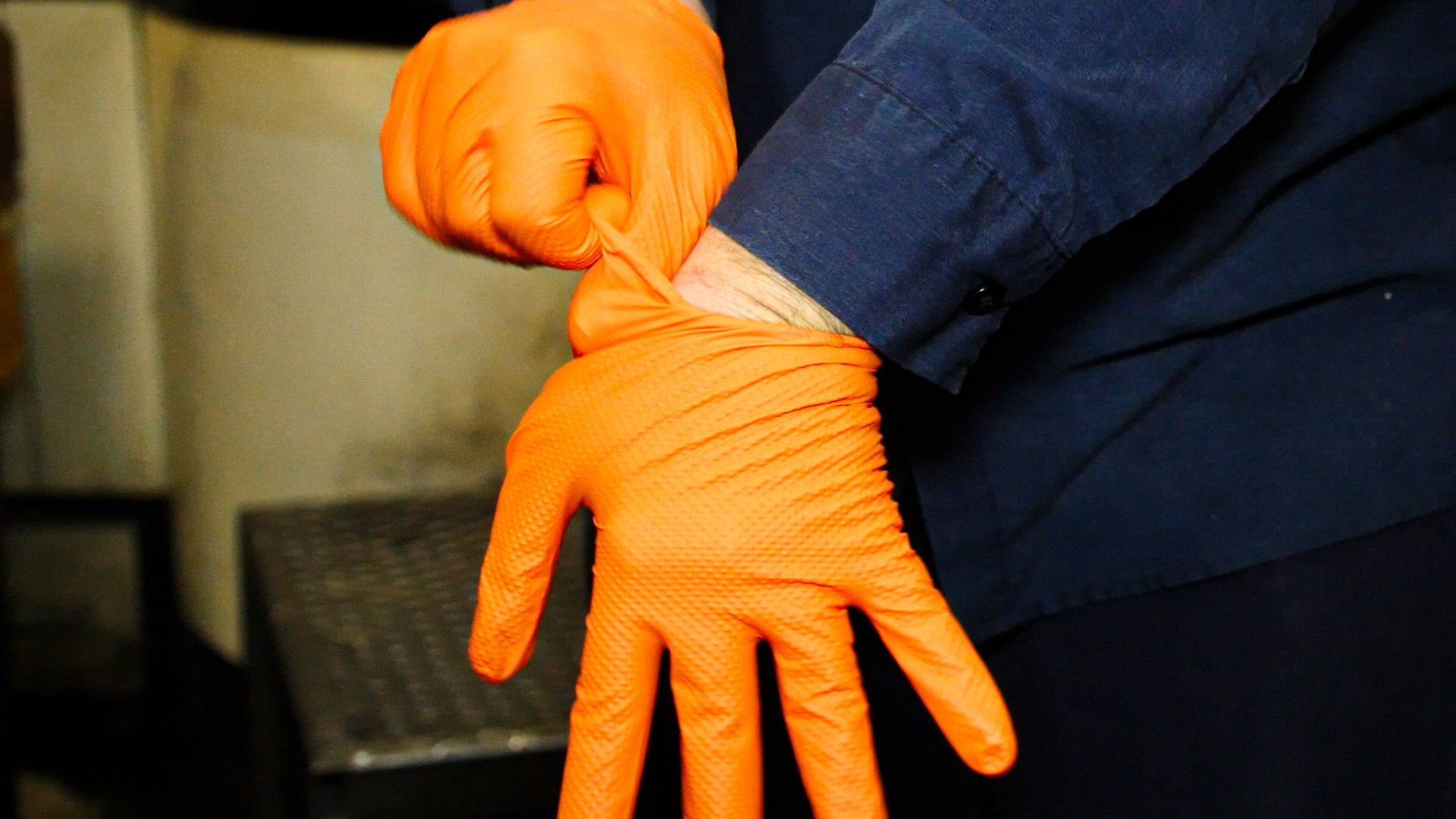
Longer Cuffs Protect the Wrist’s Splash Zone
Cuff length controls how much of your wrist and lower forearm stays covered once liquid starts moving. On the job, splash exposure rarely hits the middle of the palm first. It finds openings, especially at the wrist where sleeves shift, hands rotate, and liquid follows gravity. A longer cuff gives you a buffer above the wrist and more overlap with your sleeve, so you are not relying on a perfect seal at a single edge.
Most gloves fall into two practical cuff categories. A standard cuff covers the wrist and a bit above it. It works when splash is low and sleeves stay put. An extended cuff adds extra length up the forearm, which helps when you rinse, spray, reach into sinks or buckets, or work in wet bays where arm angles change constantly. The extra length is not just “more glove.” It is more overlap and more forgiveness when sleeves ride up or your hand twists.
If a longer cuff feels restrictive, the problem is usually fit, cuff diameter, or sleeve setup, not the length itself. A glove that is too small is already under tension, so extra cuff length can feel like it is tugging. A bunched sleeve or badly placed tape can create a pinch point that makes wrist flexion feel tight. Cuff length improves coverage, and mobility stays high when the glove fits correctly and the sleeve overlap matches how splash actually hits your arm.
Match Cuff Coverage to Your Daily Splash Tasks
The quickest way to choose the right cuff is to focus on what your hands actually do during a shift. List your top glove-wearing tasks and the movements they require, because splash risk depends on motion and direction. Common examples include mixing chemicals, pressure spraying equipment, reaching into sinks or buckets, dishwashing or janitorial sink work, wiping surfaces, or handling wet components on a line. Each creates a different pattern of liquid travel.
Pay attention to direction. Wipe-down work usually creates low, predictable splash on the palm and fingertips, so a standard cuff is often enough if you still maintain overlap at the wrist. Pouring chemicals can be deceptive. Splash may be minimal until a container “glugs,” then a burst can hit the wrist and forearm. Dishwashing and sink work often involve constant low-level exposure where repeated wetting works into gaps over time.
Higher-direction tasks need more coverage. Pressure spraying can drive liquid upward, and reaching into buckets, sinks, or parts washers puts your forearm in the splash zone while your wrist is flexed. Dunking parts is a classic wrist-risk task because you lower and lift objects while the glove is angled downward. In these scenarios, an extended cuff protects where exposure happens most, the wrist and lower forearm, and gives you more room to set reliable sleeve overlap without sacrificing movement.
Balance Coverage and Mobility With a Reach Test
Use a simple framework: start with the exposure zone, then confirm mobility with a quick movement test before you commit to a case. Step one is coverage. If your task regularly puts liquid at wrist height or above, involves reaching into wet containers, spraying, or heavy wash-down, an extended cuff is usually the better choice. If splash is light and you need maximum tactile control, a standard cuff can be the right balance.
Step two is the reach and bend test. Put the glove on, then flex your wrist forward and back. Rotate your forearm as if turning valves or using a spray wand. Finally, simulate an overhead grasp, like reaching for a hose or handle. Watch for three issues: binding at the wrist crease, the cuff catching on the sleeve and pulling the glove down, or the cuff rolling or collapsing with repeated motion. If you see these problems, the fix may be a different size, cuff diameter, or sleeve setup, not automatically a shorter cuff.
Step three is seal under movement. A glove that feels fine standing still can fail when you work fast, sweat, and change grips. The cuff should stay in place, maintain overlap with the sleeve, and resist rolling as forearm muscles flex. If your work includes repetitive twisting, scrubbing, or tool handling, check whether the cuff edge migrates downward over time. The right cuff length is the one that keeps coverage consistent through motion, not just the one that looks longer on paper.
Use Sleeve Overlap to Block Wrist Run-In
Cuff length helps, but technique turns coverage into real protection. A common, preventable failure is run-in at the wrist, when liquid travels along the sleeve or glove edge and ends up inside the glove. Decide on sleeve-over-glove or glove-over-sleeve based on where liquid comes from: below, above, or all around.
For splash from below or immersion work, glove under sleeve is often safer. If the sleeve sits over the glove, liquid can run down the sleeve and funnel into the glove opening. Wearing the glove under the sleeve reduces that effect because the sleeve ends outside the glove opening. An extended cuff adds overlap area so the sleeve stays in place even when your arm is wet and moving.
For overhead drips or splash from above, glove over sleeve can reduce exposure. If you are working under equipment, cleaning overhead surfaces, or dealing with condensate, you do not want liquid running down your sleeve onto your wrist. Pulling the glove cuff over the sleeve creates a barrier that helps block run-off before it reaches skin. The tradeoff is removal. You do not want to trap chemicals inside the glove or let liquid pool at the cuff edge.
Follow site safety policies, especially in regulated environments where specific PPE configurations are required. If chemicals could be trapped inside the glove, doffing, rinsing, and glove-change procedures matter as much as cuff length. The goal is consistent, predictable protection without creating a hidden exposure path.
Boost Comfort With Wider Cuffs and Fast Changes
Comfort is what keeps people wearing gloves correctly for the full task. Two details affect comfort and mobility more than many teams expect: cuff diameter and how quickly gloves can be put on and removed. Gloves that are hard to don encourage aggressive snapping that increases tearing. Gloves that are hard to remove encourage over-wearing, sweat buildup, and shortcuts during hygiene steps.
A slightly larger cuff opening can make a big difference. It speeds changes, reduces friction during donning, and helps when hands are damp, especially in wet stations where gloves are changed frequently. If your team changes gloves often, prioritize a glove that comes off cleanly. That supports hygiene, reduces contamination risk, and helps workers avoid leaving gloves half-on or poorly seated at the wrist.
Mobility also depends on how the cuff behaves once worn. If the cuff is too tight, it can cut in when you bend your wrist even if the fingers fit well. If it is too loose, it can catch on sleeves and roll. Fit the hand correctly first, then evaluate cuff comfort during the reach and bend test. When comfort and speed are built into the choice, people are more likely to maintain overlap and change gloves when they should.
Choose CHAMPION, NIGHTWATCH, or BODYGUARD by Task
Matching cuff length and thickness to the job reduces failures and improves compliance. For high-splash, dirty industrial work where coverage and durability matter most, CHAMPION (8 mil) is the workhorse choice. Heavy cleanup, automotive service, industrial spraying, and wash-down tasks punish gloves with abrasion, tool contact, and repeated wetting at the wrist.
For general cleaning and mixed work, NIGHTWATCH is the balanced option. These jobs may include wiping, rinsing, handling materials, and returning to light splash. You still need wrist protection, but you also need comfort and responsiveness across tasks.
For exam, food prep, and other low-splash tasks where dexterity is the priority, BODYGUARD is the best fit. When splash risk is lower and the work depends on touch and fine motor control, a lighter glove with a standard cuff often makes sense.
For a simple strategy that improves safety and reduces waste, stock by station. Keep heavier-duty gloves like CHAMPION at wet stations, wash bays, chemical mixing points, and anywhere spraying or immersion happens. Keep lighter gloves like BODYGUARD at prep, inspection, packaging, and finishing stations. Use NIGHTWATCH as the flexible bridge for teams that move between zones.
Five-Point Checklist for Confident Cuff Selection
For better splash protection without losing mobility, treat cuff length as part of a complete setup. Wrist and forearm coverage matters because that is where exposure sneaks in, but the best results come from pairing the right cuff with the right fit and the right sleeve overlap for your splash direction.
Use this five-point checklist before ordering or standardizing gloves in a work area. First, splash direction. Second, reach depth. Third, sleeve type. Fourth, change frequency. Fifth, grip requirements.
When you are ready, the next step is matching cuff length, thickness, and station-based stocking so your glove program fits the work instead of forcing the work to fit the glove. Choose a setup that prevents run-in at the wrist, keeps hands moving naturally, and puts the right level of protection where splash actually happens.