
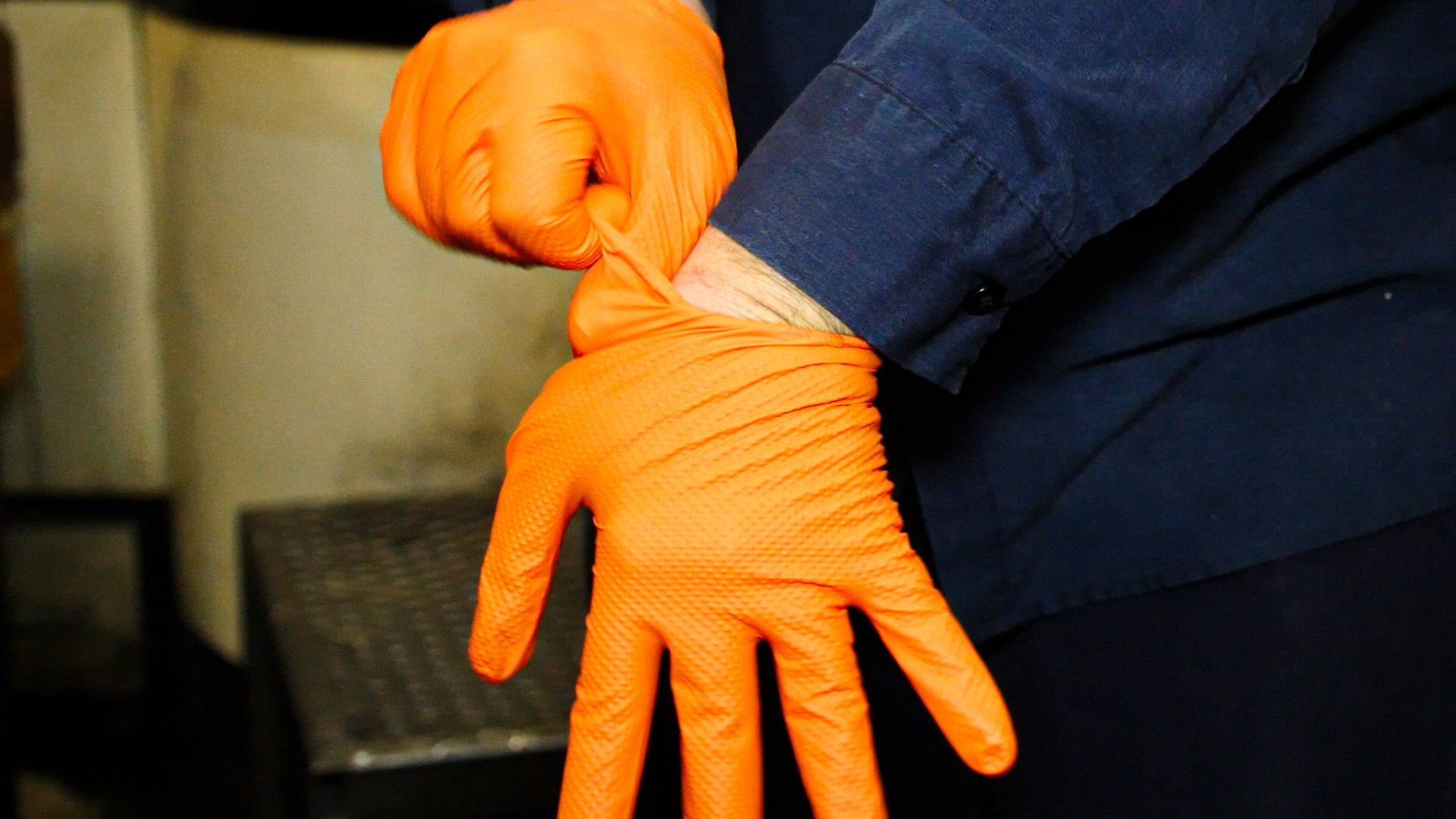
Choose the right size and prep dry hands
Most cuff tears start before the glove is even on your hand. The usual culprits are moisture, sharp edges, and a glove that is fighting your hand because it is too small. Start by choosing the right size, because an undersized glove forces you to stretch the cuff past its comfort zone. Then prep your hands like you would before any precision work: dry them completely and remove anything that can snag. Rings, watches, bracelets, and even a rough hangnail can catch the rolled edge of the cuff and turn a small tug into a split.
Hand moisture matters more than most people expect. Sweat increases friction, and friction makes you pull harder, which puts extra stress on the cuff. If you are coming from a warm environment, moving quickly between tasks, or wearing gloves for extended periods, take 10 seconds to reset. Dry with a clean towel, or if your process allows it, use a light dusting of glove-friendly powder so the glove slides on instead of grabbing your skin. The goal is simple: reduce resistance so you do not have to muscle the glove into place.
Check the cuff and seams for weak spots
A quick inspection saves time, product, and frustration. The cuff is the part of the glove that takes the most stretching during donning, so any tiny flaw there gets amplified fast. Before you put a glove on, glance at the rolled cuff and the seam area and look for irregular edges, small cuts, or thin spots. If the cuff looks uneven, slightly split, or wavy in a way that suggests it did not form cleanly, do not try to make it work. That glove might survive light use, but it is far more likely to tear the moment you widen the opening.
This matters even more in high-tempo environments like automotive bays, industrial cleanup, or back-of-house food prep where you are donning multiple pairs per shift. When your workflow is fast, it is tempting to ignore a small defect and push through. Do the opposite and discard questionable gloves early. A cuff tear mid-donning often leads to grabbing another glove with contaminated hands, wasting time, and risking exposure. A two-second check is cheaper than a restart.
Pinch the cuff opening for an easy slide-on
The fastest way to rip a cuff is to pull from the wrong place. When people grab the glove by the fingertips and yank, the glove twists, the cuff stretches unevenly, and the rolled edge takes the hit. Instead, use a simple pinch-and-pull method that spreads the force across the cuff opening. Hold the glove with your opposite hand and pinch the cuff near the wrist opening. Gently widen the opening, just enough to create a clean entry, rather than stretching it to the limit.
As you slide your hand in, keep your fingers together and your nails flat. Fingertips pushing forward like separate spears can catch and stress the glove, especially if your nails are long or your hands are damp. Aim for a smooth, wedge-like shape: fingers together, thumb tucked close until the glove is mostly on. Once your palm is seated inside the glove, release the cuff. Let the glove settle around your hand naturally, instead of forcing it into place by pulling at the edge.
Seat the palm first, then smooth the cuff
If you remember one technique detail, make it this: seat the palm first. When the palm is properly positioned, the glove has a stable anchor point, and every adjustment afterward takes less tension. After your fingers are in, press your palm down into the glove and let the material settle across the knuckles. If you feel tightness at the knuckles, do not respond by yanking on the cuff. Instead, tug the glove material from the palm area and the back of the hand, inching it into place so the glove stretches evenly.
Working down the wrist should be gradual. Pull a little from the palm and lower hand, then smooth toward the wrist. This keeps the cuff from becoming the handle that takes all the stress. Once the glove is mostly seated, finish by smoothing or gently rolling the cuff into position. Avoid snapping the cuff. Snapping feels fast, but it overstretches the rolled edge and can create micro-tears that fail later, especially if you are moving between wet and dry surfaces or doing tasks that flex the wrist repeatedly.
Spread tension evenly for a tear-free cuff
Two habits cause most cuff failures: over-stretching and one-finger hooking. Over-stretching happens when someone tries to force a glove that is slightly too small, or when they keep widening the cuff far past what is needed. Nitrile is strong, but it has limits, and the rolled cuff is not designed to be stretched like a rubber band. The second habit is even more damaging: hooking one finger inside the cuff and pulling hard. That move concentrates all the force into a tiny point, which is exactly how you start a tear at the edge.
When resistance is high, treat it as useful feedback. Stop and reassess rather than pulling harder. If the glove feels like it is biting at the knuckles or the cuff looks strained before it is even seated, you likely need a larger size. If your size is correct but the job demands aggressive donning, frequent changes, or you are working with rough surfaces that will stress the glove immediately, step up in durability. In our lineup, CHAMPION is built for heavy tasks where you cannot afford a failure during donning or in the first few minutes of work.
Pick the right mil thickness for your work
Thickness is not just about puncture resistance, it also affects how a glove behaves when you put it on. Thicker gloves typically have more structure, which can make the cuff easier to control during donning, especially when you need to pull firmly or you are wearing gloves back-to-back for hours. For industrial work, automotive service, maintenance, and heavy cleanup, we often recommend CHAMPION (Orange) 8 mil. That added thickness helps the cuff and hand area handle stronger pulls without stretching to the breaking point, and it stands up better once you are working around abrasive parts and sharp edges.
For general cleaning, light-duty tasks, and food prep, dexterity and comfort often matter more than maximum thickness. In those cases, NIGHTWATCH (Black) 6 mil is a strong middle ground. It is thick enough to feel dependable, but it typically dons with less resistance than ultra-thick gloves, especially when hands are dry and the glove is sized correctly. The key is matching the glove to the pace and stress of the job. If you are tearing cuffs during donning, it is a sign that either the glove is undersized, the technique is concentrating force at the cuff, or the glove is not built for the way your team is using it.
Do a quick fit check before you start
Once the glove is on, take a quick moment to confirm fit before you touch tools, chemicals, or food. Flex your fingers fully, make a fist, and then open your hand wide. Pinch the fingertips lightly to check that the glove is seated without extra tension pulling from the cuff. Then rotate your wrist and bend it forward and back. If the cuff feels like it is under constant strain, that tension will show up as a tear later, often right when you are in the middle of a task and cannot stop easily.
Watch for cuff creep, too. If the cuff slowly rolls or slides, it can tempt people to keep tugging it back into place, which repeatedly stresses the same edge. If you notice creep or strain, do not keep adjusting the same glove. Swap to a better size, and if your work includes frequent wrist movement or repeated glove changes, consider stepping up in thickness for better structure and durability. A glove that fits well should feel secure without feeling like it is fighting you.
Quick steps for tear-free nitrile glove donning
Q: How do you put on nitrile gloves without tearing the cuff?
A: Dry your hands, remove jewelry, and inspect the cuff for defects. Pinch the cuff to widen the opening, slide your fingers in together, and seat the palm first. Pull the glove down from the palm and wrist, never yank the cuff. If it feels overly tight, switch sizes or a thicker glove.